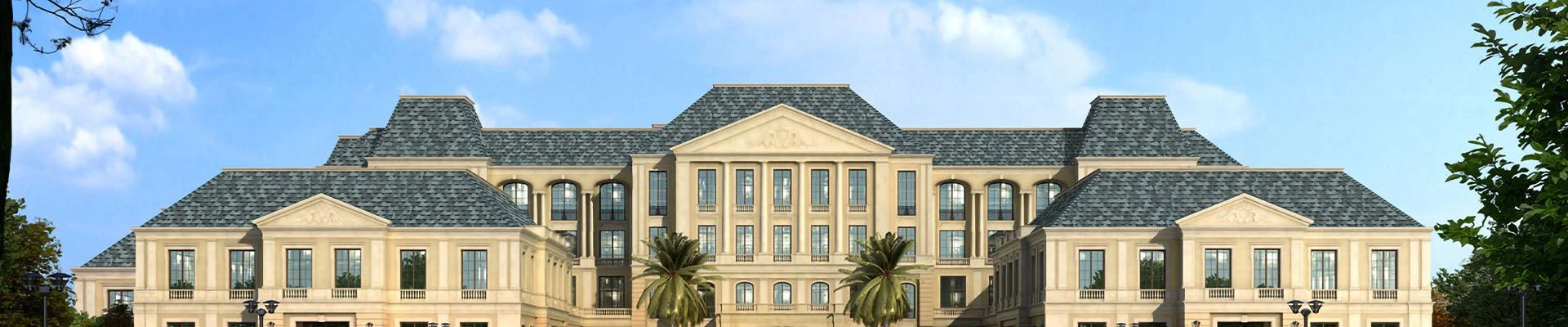
Fiberglass tile (scientific name: fiberglass asphalt tile) is also called asphalt tile and linoleum tile in China. It originated in North America and has a history of more than 80 years.
The earliest asphalt shingles were made of paper tires. Since the appearance of glass fiber tires more than 40 years ago, they have gradually replaced paper tires. Paper tires are prone to mildew and are not fireproof (only up to the American Class C fire protection standards), so they cannot be used in permanent buildings. There are still paper asphalt shingles in North America, which are only used for temporary construction.
Europeans have only used fiberglass tiles for more than 30 years, and the amount used is relatively small. The annual consumption of fiberglass tiles in Europe is about 60 million square meters. Europeans often use fiberglass tiles for the decorative part of the roof instead of laying the entire roof.
According to statistics, 2.86 billion square meters of fiberglass tiles were used in North America in 2003, and 4.5 billion square meters (construction area) in 2006. Because North Americans have to move home many times in their lives, and fiberglass tiles are very cheap (currently around US$2.2/m2), so when they arrive at a new home, they may change the roof to their favorite color or tile type, even if they don’t move. They also often replace the fiberglass tiles on the roof.
Fiberglass tiles are used by middle- and low-income people in the United States, so the consumer group is aimed at most people. In the United States, those with an annual income of over one million will use slate tiles, those with an annual income of 200,000 to 1 million will use shingles, plastic tiles and other imitation slate-like tiles, and those with an annual income of less than 200,000 will use fiberglass tiles.
Domestic fiberglass tile situation: In the 1980s, Tianjin and Wuhan introduced multifunctional modified asphalt coil production lines, but they have been unknown in the market. At the end of the twentieth century, Beijing, Shanghai and other coastal cities promoted the use of "flat-to-slope" colored glass fiber tiles for building sloping roofs. This kind of roofing material with both waterproof and heat insulation properties has made great progress in our country. . Because of its beautiful appearance, light weight, good waterproof performance, easy transportation, and convenient installation, fiberglass tiles have been widely used in many places in my country, and some products are exported overseas. After that, colored glass fiber tiles will become the "new favorite" of my country's roofing materials.
In the 1990s, my country formulated the JC/T503-1992 "Linoleum Tile" industry standard. The technical indicators and test methods of this standard are basically in accordance with the provisions of modified asphalt coils, which can no longer meet the needs of the development of current production and use forms.
The newly formulated "Glass Fiber Asphalt Shingles" national standards refer to ASTM D3462-2005 "Glass Fiber Tire and Mineral Material Covered Asphalt Shingles" and PrEN544-2004 "Mineral and Synthetic Tire Base Asphalt Shingles Product Standards and Test Methods". The attached modification adopted EN12039: 1999 "Flexible waterproofing membrane-Asphalt membrane for roof waterproofing-Mineral material adhesion", and the modification of wind resistance adopted ASTM D3161-2003 "Asphalt shingle wind resistance test method (fan method) ". The advanced technical indicators and test methods in European and American standards are adopted, such as the adhesion of mineral particles, the accelerated aging of artificial weather, and the performance of wind resistance. The standards have reached the international advanced level.
The formulation and implementation of the new national standard of "Fiberglass Asphalt Shingles" will improve the product quality of my country's fiberglass tiles to a new level and push the production of fiberglass tiles to a new level.